
NEWS & INSIGHTS · October 20, 2026
Carbon Fiber Break Cue vs. Playing Cue: Key Differences Explained
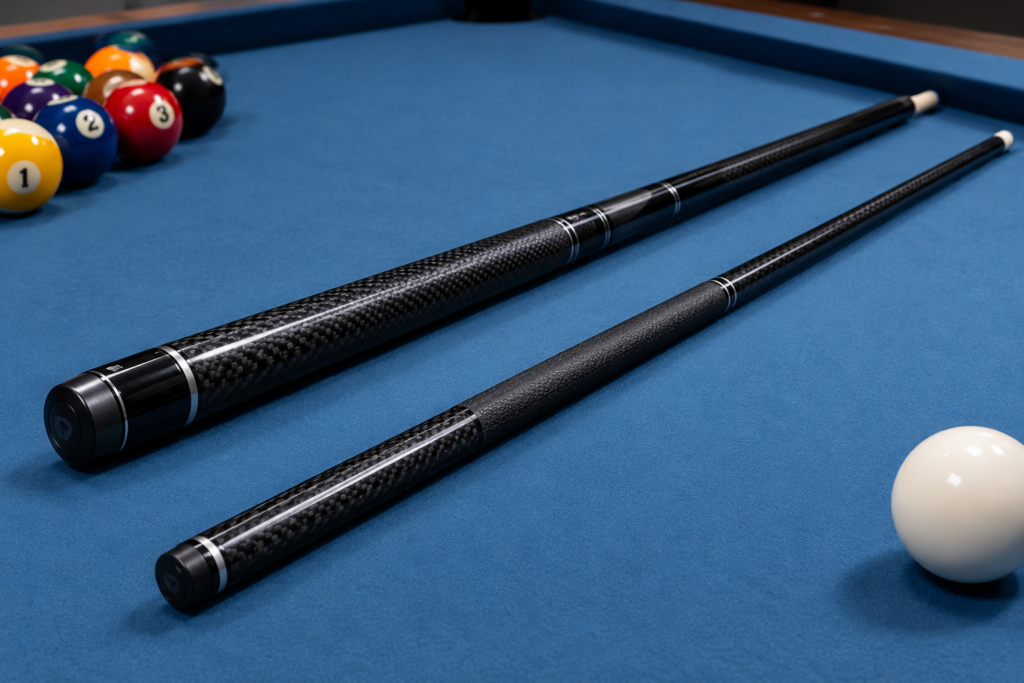
Carbon fiber pool cues have become a popular choice among billiards players because of their durability, consistent performance, and modern construction. However, not every carbon fiber cue is designed for the same purpose. A break cue and a playing cue may use similar materials, but they are built to meet different performance requirements.
Understanding the differences between a carbon fiber break cue and a carbon fiber playing cue can help players, billiard clubs, retailers, and pool cue distributors choose the right equipment.
In this guide, we will compare their shaft stiffness, tip design, weight distribution, construction, and intended use. We will also explain what buyers should consider when selecting carbon fiber cues for personal use or commercial purchasing.
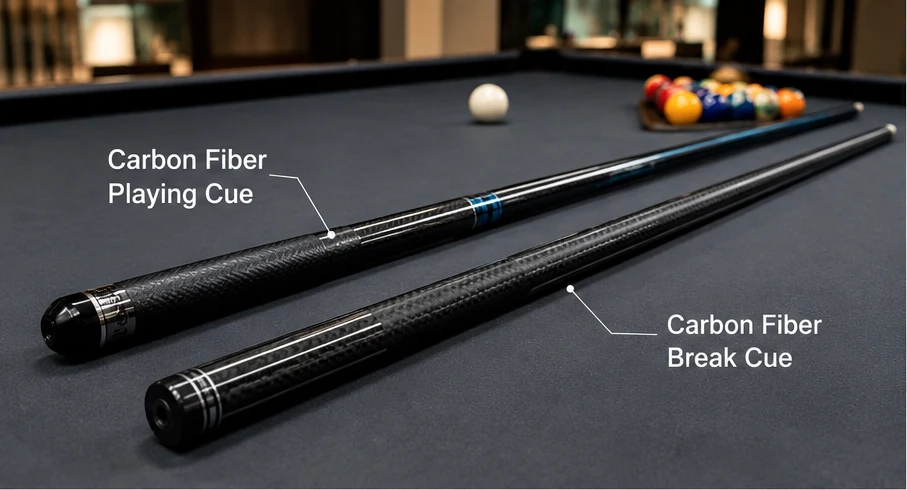
1. What Is a Carbon Fiber Playing Cue?
A carbon fiber playing cue is designed for regular shots throughout a game of pool. Players use it to control the cue ball, position it for the next shot, apply spin, and maintain accuracy.
Because precision and consistency are essential during regular play, playing cues are generally designed to provide a predictable response and comfortable handling.
Key Features of a Carbon Fiber Playing Cue
- Precision and control: Designed to support accurate shot-making and cue ball positioning.
- Consistent shaft performance: Carbon fiber construction can help reduce changes in shaft behavior caused by humidity and temperature compared with many wooden shafts.
- Low-deflection options: Many modern carbon fiber playing shafts are engineered to reduce cue ball deflection when applying sidespin, although actual performance varies by design.
- Comfortable handling: Shaft diameter, taper, weight, balance, and grip all influence the player’s experience.
- Versatile use: Suitable for a wide range of shots, including draw shots, follow shots, stun shots, and positional play.
A playing cue is particularly suitable for players who value repeatable performance and precise cue ball control.For more guidance, read our guide on how to choose the right carbon fiber pool cue shaft.
2. What Is a Carbon Fiber Break Cue?
A carbon fiber break cue is designed primarily for the opening break shot, when a player strikes the cue ball with the goal of spreading the object balls effectively.
Breaking requires a different combination of power, stability, and impact resistance from the qualities emphasized in a regular playing cue.
Key Features of a Carbon Fiber Break Cue
- Impact-oriented construction: The shaft and overall cue are designed for the demands of forceful break shots.
- Suitable shaft stiffness: A firmer shaft response may appeal to players who prefer a more direct feel during the break.
- Break-specific tip: Break cues commonly use harder tips than playing cues to support efficient energy transfer and consistent contact.
- Power-oriented balance: The cue’s weight distribution can influence swing feel and acceleration.
- Durable materials: Properly designed carbon fiber construction can offer good resistance to moisture-related changes and regular wear.
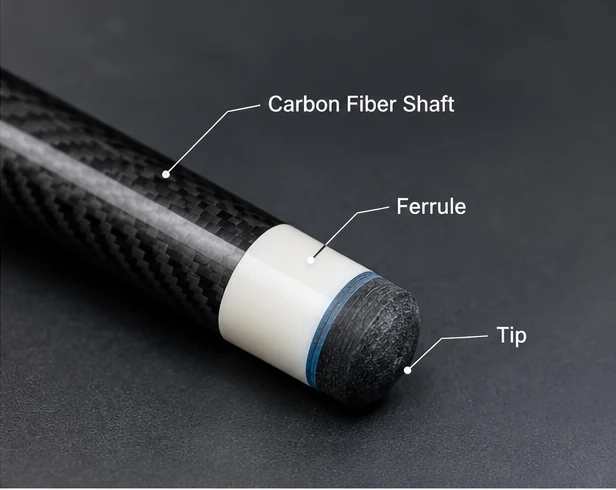
Not all break cues have identical specifications. Shaft stiffness, tip hardness, cue weight, and balance vary by manufacturer and model. A well-designed break cue should match the player’s technique rather than simply maximize stiffness or weight.
3. Carbon Fiber Break Cue vs. Playing Cue: Main Differences
Although both cue types may use carbon fiber shafts, their design priorities are different.
| Feature | Carbon Fiber Playing Cue | Carbon Fiber Break Cue |
|---|---|---|
| Primary purpose | Regular shots and cue ball control | Opening break shots |
| Main design priority | Accuracy, spin, and consistency | Power, stability, and impact performance |
| Shaft feel | Often designed for controlled, predictable play | Often firmer, depending on the model |
| Tip | Usually softer or medium, depending on player preference | Usually harder for break-shot demands |
| Deflection | Low-deflection performance may be a priority | Design priorities depend on the break system |
| Weight and balance | Tuned for comfortable all-around play | Tuned to the player’s preferred breaking technique |
| Shot variety | Designed for a broad range of shots | Primarily designed for breaking |
| Typical user | Recreational and competitive players | Players seeking a dedicated break setup |
Shaft diameter is another important factor when comparing pool cues. Learn more in our carbon fiber pool cue shaft diameter guide.These are general design tendencies, not universal rules. Some playing cues have firm shafts, and some break cues are relatively light. Product specifications and actual performance should always be checked before purchasing.
4. Shaft Stiffness: Control vs. Impact Performance
Shaft stiffness is one of the most discussed differences between break cues and playing cues.
A playing shaft is designed to provide a consistent response during a variety of shots. Players need to judge speed, spin, contact point, and cue ball movement with confidence. A shaft that feels comfortable and predictable can help them repeat their technique.
A break shaft, by comparison, is often designed to feel firm and stable under the high-speed impact of a break shot. However, a stiffer shaft does not automatically produce a more powerful break. Cue speed, acceleration, tip contact, timing, and the player’s technique remain important factors.
For buyers comparing carbon fiber shafts, consider the following specifications:
- Shaft diameter and taper
- Wall thickness and structural design, where disclosed
- Overall shaft length
- Tip and ferrule configuration
- Joint compatibility
- Intended playing or breaking application
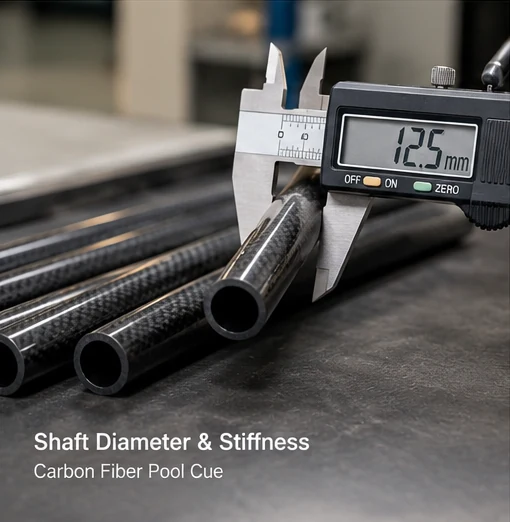
Manufacturers may use different layup designs, resin systems, and structural configurations. Therefore, two carbon fiber shafts with similar external dimensions can still feel different in use.
5. Tip Design: Why Break Cues Often Use Harder Tips
The cue tip is the contact point between the cue and the cue ball. Its material and hardness influence grip, feel, maintenance, and performance.
Playing Cue Tips
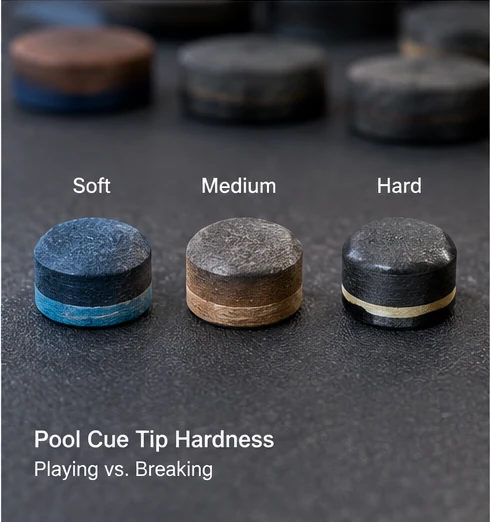
Playing cues commonly use leather tips in soft, medium, or hard options. Softer and medium tips are often chosen by players who prefer a particular feel or who use spin frequently. Harder playing tips are also popular with some players.
The best tip depends on the player’s technique, preferred feedback, and maintenance habits. Tip hardness alone does not determine accuracy or spin.
Break Cue Tips
Break cues commonly use harder leather tips or other purpose-designed tip materials. A harder tip may deform less during impact and can provide a firmer feel for powerful break shots.
However, tip material, tip shape, installation quality, and contact consistency all matter. A hard tip is not automatically better for every player, and some specialized break setups use different materials.
When selecting a cue, buyers should confirm the tip material, diameter, replacement options, and whether the manufacturer offers customization.
6. Weight and Balance: What Should Players Consider?
Cue weight affects how a cue feels during acceleration and impact. Balance affects how the cue moves in the player’s hand and how easily the player can maintain a repeatable stroke.
Some players prefer a heavier break cue because it feels stable during their swing. Others prefer a lighter setup that allows them to accelerate comfortably. There is no single ideal weight for every player.
Playing cues also come in different weight configurations. The right setup depends on stroke mechanics, comfort, and the player’s preferred balance point.
Before buying a cue, consider:
- Total cue weight
- Front-to-back weight distribution
- Balance point
- Shaft and butt weight
- Whether the cue includes adjustable weight bolts
- Whether the cue is available in the preferred length and specifications
For distributors and billiard clubs, offering several weight options may help meet the preferences of different customers.
7. Can You Use a Playing Cue to Break?
Yes, a playing cue can be used to break in many situations. However, whether this is advisable depends on the cue’s construction, the manufacturer’s recommendations, and the player’s breaking technique.
Players who break with their regular playing cue may avoid carrying an additional cue, but repeated high-impact use can place additional demands on the tip, ferrule, shaft, and joint.
A dedicated break cue provides an alternative designed specifically for break shots. It can also allow players to keep their regular playing cue configured for their preferred shot-making performance.
If you choose to break with a playing cue, avoid excessive force beyond the cue’s intended use and follow the manufacturer’s care instructions.
8. Can You Use a Break Cue for Regular Shots?
A break cue can physically strike the cue ball during regular play, but it is not necessarily the best tool for every shot.
Break cues often use harder tips and a firmer overall setup. These characteristics may feel less suitable to players who depend on delicate touch, frequent spin, and precise cue ball positioning.
A playing cue is usually the better choice for general shot-making because its design is intended to support a broad range of shots throughout the game.
For players who want to improve consistency, using separate cues for playing and breaking can make it easier to maintain a familiar setup for each task.
9. Carbon Fiber Break Cue vs. Carbon Fiber Playing Cue: Which Should You Choose?
The right cue depends on how you play, your budget, and your performance priorities.
Choose a Carbon Fiber Playing Cue If:
- You want a cue for regular games and a wide range of shots.
- Cue ball control and predictable feedback are important to you.
- You frequently use draw, follow, stun, and sidespin.
- You want a cue that is less sensitive to environmental changes than many traditional wooden shafts.
- You prefer to customize shaft diameter, taper, weight, or balance for your playing style.
Choose a Carbon Fiber Break Cue If:
- You want a dedicated cue for opening breaks.
- You prefer a firmer feel during high-impact shots.
- You want a setup with a break-specific tip and suitable balance.
- You play regularly and want to keep your playing cue separate from your breaking equipment.
- You are a club operator or retailer looking to offer specialized cue options.
Should You Buy Both?
For frequent players, owning both a playing cue and a break cue can be practical. Each cue can be selected and maintained for its intended purpose.
For beginners or occasional players, starting with a suitable playing cue may be sufficient. A dedicated break cue can be added later if the player’s needs and budget justify it.
10. What Should Buyers Check When Sourcing Carbon Fiber Cues?
For retailers, billiard clubs, importers, and private-label brands, product selection involves more than comparing the listed price.
Before placing an order, review the following factors.
Product Specifications
Confirm cue length, shaft diameter, weight range, tip material, joint type, balance, and available configurations. Make sure the specifications match the intended market.
Manufacturing Consistency
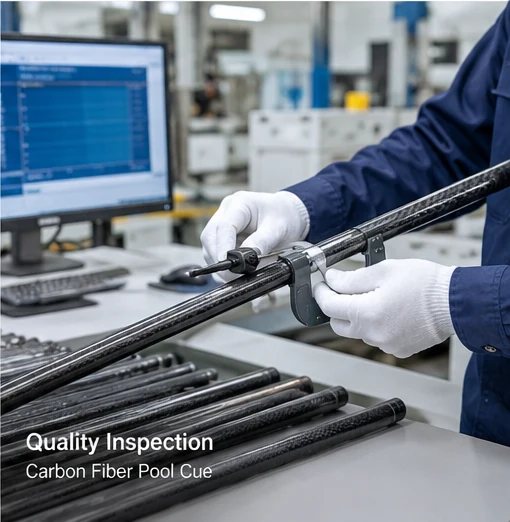
Ask how the supplier checks dimensions, straightness, surface finish, joint fit, and assembly quality. Request samples if you need to evaluate product consistency before a larger order.Choosing the right manufacturing partner is equally important. Read our guide on how to choose a reliable carbon fiber pool cue manufacturer in China.
Customization Options
If you are building your own brand, ask about logo printing, shaft and butt designs, colors, packaging, and other available OEM or ODM services.
Sample Development and Lead Time
Confirm sample availability, sample charges, production lead time, minimum order quantity, and shipping arrangements. Custom designs may require additional development time.
Communication and Quality Assurance
A reliable supplier should clearly explain specifications, confirm customization details, and provide a defined process for handling production issues.
For businesses sourcing carbon fiber playing cues and break cues, these checks can help reduce specification misunderstandings and support more consistent purchasing decisions.
11. Custom Carbon Fiber Pool Cues for Brands and Distributors
Different markets may prefer different shaft diameters, cue weights, visual designs, and price points. Retailers and distributors should therefore consider whether their supplier can support more than one standard configuration.
Cheval Carbon focuses on carbon fiber billiard cue manufacturing and offers OEM/ODM customization options for businesses seeking products tailored to their brand requirements.
Depending on the model and production requirements, buyers can discuss options such as:
- Shaft and butt design
- Logo and visual customization
- Product specifications and configurations
- Sample development
- Packaging requirements
If you are planning to develop your own line of carbon fiber pool cues, prepare your target specifications and estimated order quantity before requesting a quotation. This helps the manufacturer assess feasibility and provide more relevant pricing and production information.
Contact Cheval Carbon to discuss your requirements for carbon fiber billiard cues and customized manufacturing solutions.
Frequently Asked Questions
1. What is the main difference between a carbon fiber break cue and a playing cue?
A playing cue is designed for regular shots, cue ball control, and a wide range of techniques. A break cue is designed primarily for opening break shots, with specifications intended to suit repeated high-impact use.
2. Are carbon fiber break cues stiffer than playing cues?
Many break cues are designed to provide a firmer feel, but this is not a universal rule. Stiffness depends on the shaft’s construction, dimensions, materials, and overall design.
3. Do break cues need harder tips?
Break cues commonly use harder tips because they are designed for high-impact contact. The best choice depends on the tip material, cue design, and player’s preferences.
4. Can I use the same carbon fiber cue for playing and breaking?
Yes, in many cases. However, a cue designed for regular play may not be optimized for repeated break shots. Follow the manufacturer’s recommendations and consider a dedicated break cue if you break frequently.
5. Does a heavier break cue produce a more powerful break?
Not necessarily. Break performance depends on cue speed, acceleration, timing, contact quality, and technique, as well as cue weight and balance. The best weight is one the player can control effectively.
6. Are carbon fiber cues suitable for professional players?
Carbon fiber cues can be suitable for players at different skill levels, including competitive players. The best cue depends on individual preferences, playing technique, and the performance characteristics of the specific model.
7. Can manufacturers customize carbon fiber playing cues and break cues?
Some manufacturers offer OEM/ODM options, including logo printing, design changes, specifications, and packaging. Available options, minimum order quantities, and lead times vary by supplier and model.
Conclusion
The main difference between a carbon fiber break cue and a carbon fiber playing cue is their intended purpose. Playing cues prioritize control, consistency, and versatility, while break cues are designed around the demands of high-impact opening shots.
When comparing models, look beyond the material alone. Shaft construction, tip selection, weight, balance, and overall build quality all contribute to the cue’s performance.
Whether you are choosing a cue for personal use or sourcing products for a billiard business, understanding these differences will help you make a more informed decision. If you need customized carbon fiber cues for your brand, discuss your specifications, sample requirements, and order plans with a qualified manufacturer before moving to production.