
NEWS & INSIGHTS · October 30, 2026
How to Choose Shuttlecocks for Badminton Training
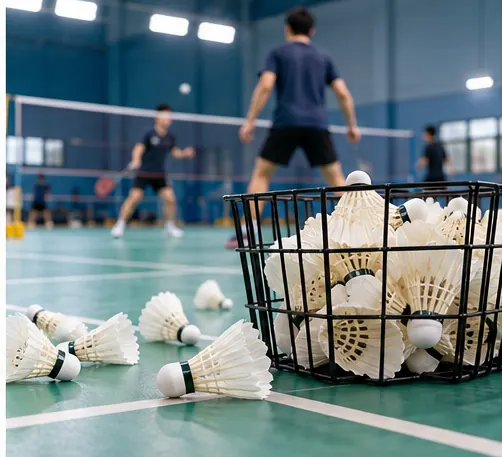
Choosing the right shuttlecocks for badminton training is essential for improving player performance, maintaining consistent practice sessions, and controlling training costs.
Whether you manage a badminton club, operate a training academy, coach professional players, or purchase badminton equipment in bulk, selecting suitable shuttlecocks can make a significant difference in training efficiency.
Different training activities require different levels of shuttlecock durability, flight stability, speed, and playing feel. While premium goose feather shuttlecocks are often preferred for advanced training, duck feather and nylon shuttlecocks can provide practical alternatives for everyday practice.
In this guide, we explain how to choose the best shuttlecocks for badminton training based on materials, durability, speed, training intensity, and budget.
1. Why Choosing the Right Training Shuttlecock Matters
Badminton training involves repetitive hitting, footwork exercises, multi-shuttle drills, and simulated matches.
Unlike casual recreational play, structured training sessions may require hundreds of shuttlecock hits within a relatively short period.
Using unsuitable shuttlecocks can lead to several problems:
- Inconsistent flight trajectories that affect shot accuracy.
- Frequent feather damage and increased replacement costs.
- Incorrect shuttlecock speed that disrupts timing and positioning.
- Reduced training efficiency during repetitive drills.
- Unnecessary interruptions when shuttlecocks need replacement.
For badminton clubs and professional training centers, the ideal shuttlecock should offer a suitable balance between durability, consistent flight performance, and cost efficiency.
The best choice depends on how the shuttlecocks will be used.
2. Understanding Different Types of Badminton Training Shuttlecocks
There are three main types of shuttlecocks commonly used for badminton training: goose feather, duck feather, and nylon shuttlecocks.
Each type offers different characteristics and advantages.
Goose Feather Shuttlecocks
Goose feather shuttlecocks are widely used in competitive badminton and advanced training programs.
They are manufactured using carefully selected natural goose feathers arranged around a cork or composite cork base.
Main advantages:
- Precise and responsive flight characteristics.
- Suitable for advanced shot-control exercises.
- Natural feather playing feel.
- Reliable performance when manufactured to consistent specifications.
- Appropriate for match simulation and competitive training.
Goose feather shuttlecocks are particularly suitable for advanced players who require consistent performance during technical training.
For example, the Cheval Carbon G4 competition-grade shuttlecock features 16 selected full-round goose feathers and a composite cork base, making it a suitable option to evaluate for precision-focused training and competitive play.
Duck Feather Shuttlecocks
Duck feather shuttlecocks are commonly selected by badminton clubs, schools, and training academies seeking a balance between performance and purchasing costs.
They provide natural feather flight characteristics while offering different price and quality options.
Main advantages:
- Suitable for regular badminton training.
- Natural feather playing characteristics.
- Available in multiple material grades.
- Practical for high-volume practice sessions.
- Often more economical than comparable premium goose feather models.
High-quality duck feather shuttlecocks can deliver stable flight and satisfactory durability when properly manufactured.
The Cheval Carbon G7 uses selected full-round duck feathers and a composite cork base. It is positioned for professional training, daily club use, and frequent play.
Nylon Shuttlecocks
Nylon shuttlecocks feature a synthetic skirt rather than individual natural feathers.
They are often used for beginner lessons, recreational badminton, and school training programs.
Main advantages:
- Generally resistant to feather-type breakage.
- Suitable for repeated recreational hitting.
- Convenient for beginners and school programs.
- Often economical over extended practice periods.
- Less sensitive to storage humidity than natural feathers.
However, nylon shuttlecocks have different flight and deceleration characteristics from natural feather shuttlecocks.
For advanced players preparing for feather-shuttle competitions, natural feather models are generally more appropriate.Learn more about the differences between natural feather and nylon shuttlecocks.
3. Goose Feather vs. Duck Feather vs. Nylon Shuttlecocks
Understanding the differences between shuttlecock materials helps coaches and purchasing managers select suitable products.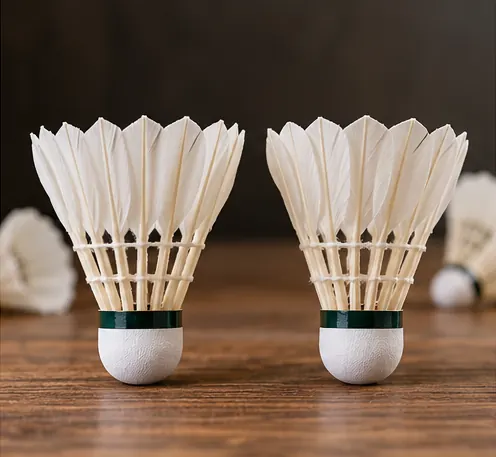
| Feature | Goose Feather | Duck Feather | Nylon |
|---|---|---|---|
| Material | Natural goose feathers | Natural duck feathers | Synthetic skirt |
| Flight characteristics | Precise natural feather response | Natural feather response | Different aerodynamic response |
| Durability | Depends on feather grade and construction | Depends on feather grade and construction | Generally resistant to feather breakage |
| Typical cost | Higher for premium grades | Often moderate | Often economical |
| Recommended use | Advanced training and match practice | Daily club training and multi-shuttle drills | Beginner and recreational training |
| Playing feel | Natural feather | Natural feather | Synthetic |
No single shuttlecock material is ideal for every training environment.
Coaches should consider the players’ skill levels, practice intensity, and budget before selecting a model.
For training academies serving different player groups, maintaining a combination of shuttlecock types can be an effective purchasing strategy.
4. How to Choose Shuttlecocks Based on Training Activities
Different badminton exercises place different demands on shuttlecock performance.
Multi-Shuttle Feeding Drills
Multi-shuttle training is widely used by badminton coaches to develop footwork, reaction speed, shot repetition, and technical consistency.
During these sessions, coaches may feed dozens or hundreds of shuttlecocks to players.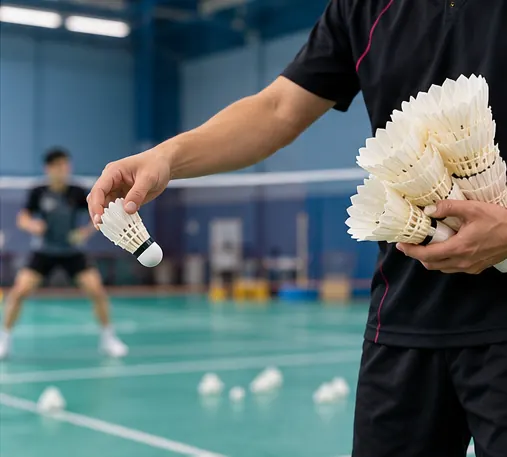
For multi-shuttle drills, the most important purchasing factors include:
- Reasonable cost per shuttlecock.
- Sufficient flight consistency for the intended drill.
- Suitable speed for the training environment.
- Availability in larger quantities.
- Consistent quality between batches.
Duck feather shuttlecocks are often a practical choice for high-volume feeding drills, particularly when training costs must be controlled.
For some basic repetition exercises, coaches may also reuse previously played feather shuttlecocks that remain sufficiently stable.
However, damaged or severely deformed shuttlecocks should not be used for drills requiring accurate trajectories.
Footwork and Reaction Training
Footwork training requires shuttlecocks that travel predictably so players can develop movement patterns and reaction timing.
Coaches should prioritize:
- Stable flight trajectories.
- Appropriate shuttlecock speed.
- Consistent weight and construction.
- Reliable landing positions.
Quality duck feather shuttlecocks can be suitable for routine footwork exercises.
Advanced players may benefit from goose feather shuttlecocks when training closely replicates competitive conditions.
Smash and Power Training
Smash training places considerable stress on shuttlecock feathers and their supporting structure.
Repeated powerful impacts may cause feather deformation, broken quills, or changes in flight performance.
When selecting shuttlecocks for smash training, consider:
- Feather shaft strength.
- Secure feather assembly.
- Cork base construction.
- Resistance to deformation.
- Replacement frequency during intensive practice.
A durable shuttlecock can help reduce interruptions and improve the efficiency of high-intensity sessions.
However, even premium natural feather shuttlecocks will eventually deteriorate under repeated powerful impacts.
Net Play and Precision Training
Net shots, drops, and controlled placements require responsive shuttlecock flight.
For these exercises, flight accuracy is often more important than the lowest purchase price.
Premium natural feather shuttlecocks are generally recommended for advanced precision training because they provide the playing characteristics commonly experienced in competitive badminton.
5. Shuttlecock Durability: What Should You Look For?
Durability is one of the most important factors when purchasing badminton training shuttlecocks.
A durable shuttlecock should maintain acceptable flight characteristics throughout repeated use.
Several factors influence shuttlecock durability.
Feather Quality
Feather selection affects structural strength, shape consistency, and resistance to deformation.
High-quality feathers should have suitable curvature, intact surfaces, and consistent dimensions.
Cork Base Construction
The shuttlecock base influences impact response and overall playing feel.
Natural cork and composite cork constructions are available, with performance varying according to material quality and manufacturing design.
Feather Assembly
Proper feather positioning, adhesive application, and thread winding help maintain the shuttlecock’s structural integrity.
Poor assembly can cause feathers to loosen or shift during play.
Training Intensity
Powerful smashes, racket-frame contact, and frequent repetitive hitting can shorten shuttlecock lifespan.
Durability should therefore be evaluated under realistic training conditions.
Storage Environment
Natural feathers can become brittle in excessively dry conditions and may deform when exposed to inappropriate moisture.
Proper storage helps maintain shuttlecock performance before use.
For clubs purchasing large quantities, it is advisable to evaluate sample shuttlecocks under normal training conditions before committing to bulk orders.
6. How to Choose the Right Shuttlecock Speed
Shuttlecock speed affects how far the shuttlecock travels under comparable hitting conditions.
Selecting the wrong speed can negatively affect timing, positioning, and overall training quality.
Commonly marketed feather shuttlecock speed grades include 76, 77, and 78, although labeling systems and actual flight performance may vary between manufacturers.
In general, within a comparable manufacturer’s grading system:
- Speed 76: A slower option that may suit warmer conditions or lower-altitude environments.
- Speed 77: A commonly selected intermediate option.
- Speed 78: A faster option that may be suitable for cooler conditions or higher-altitude environments.
These are general guidelines rather than universal rules.
Temperature, altitude, air density, and the manufacturer’s grading system can all influence the correct choice.
The best approach is to test shuttlecocks at the actual training venue and evaluate their flight distance.
Badminton clubs purchasing shuttlecocks internationally should communicate their local playing conditions to the manufacturer before confirming speed specifications.
7. How to Balance Shuttlecock Quality and Training Costs
For badminton academies and training centers, shuttlecock purchasing is an ongoing operating expense.
Choosing the cheapest shuttlecock is not always the most economical strategy.
Low-quality shuttlecocks may require frequent replacement, resulting in higher total consumption.
Instead, purchasing managers should evaluate the cost per effective training session.
Important factors include:
- Purchase price per dozen.
- Average number of shuttlecocks consumed per session.
- Flight consistency throughout use.
- Replacement frequency.
- Suitability for different training activities.
- Quality consistency across repeat orders.
For example, a training center may choose economical duck feather shuttlecocks for high-volume drills while reserving premium goose feather shuttlecocks for advanced technical exercises.
This approach can help control costs without unnecessarily compromising training quality.
8. How to Test Shuttlecocks Before Bulk Purchasing
Before placing a large wholesale order, badminton clubs and distributors should evaluate product samples.
A practical sample evaluation process should include the following steps.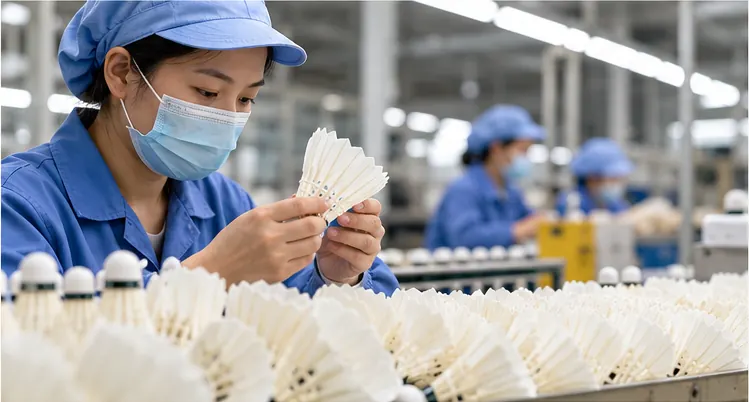
Step 1: Check Appearance and Construction
Inspect feather alignment, cork base quality, overall shape, and visible manufacturing defects.
Step 2: Test Flight Stability
Perform consistent clears and controlled shots to observe shuttlecock trajectories and landing positions.
Step 3: Evaluate Speed
Test the shuttlecocks under the actual temperature and playing conditions of the training venue.
Step 4: Measure Durability
Use the shuttlecocks in representative training drills and record how frequently they become unsuitable for continued use.
Step 5: Compare Training Costs
Calculate the approximate number of shuttlecocks consumed during comparable training sessions.
Step 6: Confirm Batch Consistency
For wholesale purchasing, ask the manufacturer how product specifications and quality inspections are maintained across production batches.
Testing samples helps buyers make informed decisions based on practical performance rather than product descriptions alone.
9. Recommended Shuttlecocks for Different Training Levels
Different player groups require different shuttlecock characteristics.
| Training Level | Recommended Type | Main Priority |
|---|---|---|
| Beginner training | Nylon or economical duck feather | Durability and cost |
| School badminton programs | Nylon or duck feather | Frequent use |
| Club daily training | Quality duck feather | Performance and value |
| Multi-shuttle feeding | Cost-effective duck feather | Volume and consistency |
| Advanced technical training | Premium duck or goose feather | Flight accuracy |
| Competition preparation | Competition-grade goose feather | Match-like performance |
Explore our complete badminton shuttlecock collection to find suitable products for different training requirements.
These recommendations should be adjusted according to individual training programs and local conditions.
10. Why Choose Cheval Carbon for Badminton Training Shuttlecocks?
Cheval Carbon Sports is a sporting goods manufacturer and supplier based in Weihai, China.
We provide badminton shuttlecock solutions for clubs, training academies, sports distributors, and international brands.
Our shuttlecock collection includes natural goose feather, duck feather, and nylon models designed for different playing requirements.
G7 Premium Duck Feather Shuttlecocks
The G7 series features selected full-round duck feathers and a composite cork base.
Designed for daily training and frequent club use, it offers a practical balance of flight performance, durability, and cost efficiency.
It is a suitable option for buyers evaluating natural feather shuttlecocks for regular training programs.
G4 Competition-Grade Goose Feather Shuttlecocks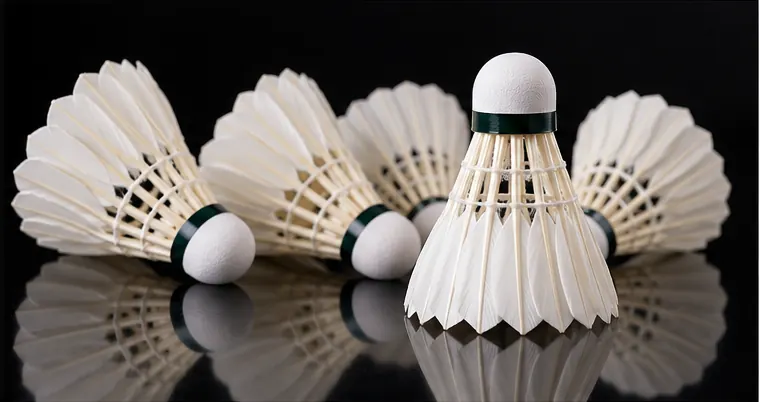
The G4 series uses 16 selected full-round goose feathers and a composite cork base.
It is developed for precision-focused play and competitive applications.
Clubs and training academies can evaluate the G4 for advanced technical sessions, match simulation, and competitive preparation.
OEM and Wholesale Manufacturing Services
Cheval Carbon also supports international customers with shuttlecock OEM/ODM services.
Available project discussions include:
- Goose feather and duck feather material options.
- Shuttlecock speed specifications.
- Cork base construction.
- Custom brand logos and packaging.
- Wholesale supply arrangements.
- Sample evaluation and quality requirements.
Customization availability, minimum order quantities, prices, and delivery schedules are confirmed according to each project’s specifications.
Whether you are building your own badminton brand or sourcing training shuttlecocks for an established club network, our team can help you evaluate suitable product options.
11. Frequently Asked Questions About Badminton Training Shuttlecocks
What are the best shuttlecocks for badminton training?
The best shuttlecocks depend on the training activity. Duck feather shuttlecocks are often suitable for daily club practice, goose feather shuttlecocks are commonly preferred for advanced training, and nylon shuttlecocks can be practical for beginners.
Are duck feather shuttlecocks good for training?
Yes. Quality duck feather shuttlecocks can provide suitable natural feather flight characteristics and cost efficiency for club training, footwork exercises, and multi-shuttle feeding drills.
Are goose feather shuttlecocks more durable than duck feather shuttlecocks?
Not necessarily in every case. Durability depends on feather grade, construction, processing, and playing intensity. Premium goose feather models may offer excellent durability, but actual products should be compared through practical testing.
Which shuttlecock speed is best for indoor badminton training?
The correct speed depends on temperature, altitude, venue conditions, and the manufacturer’s grading system. Speeds 76, 77, and 78 are common options, but on-court testing is recommended.
Are nylon shuttlecocks suitable for professional training?
Nylon shuttlecocks can be useful for certain drills, but advanced players preparing for feather-shuttle competitions generally benefit from practicing with natural feather shuttlecocks.
How many shuttlecocks does a badminton training session need?
The quantity depends on the number of players, drill intensity, shuttlecock quality, and session duration. Multi-shuttle training generally consumes more shuttlecocks than ordinary recreational play.
Can badminton clubs order customized shuttlecocks?
Yes. Manufacturers offering OEM/ODM services may provide customized branding, packaging, material options, and speed specifications, subject to production requirements.
Conclusion
Choosing the right shuttlecocks for badminton training requires balancing flight performance, durability, speed, training intensity, and purchasing costs.
For regular club training and multi-shuttle drills, quality duck feather shuttlecocks can provide a practical combination of performance and value.
For advanced technical training and competition preparation, premium goose feather shuttlecocks are often a suitable choice.
Nylon shuttlecocks remain useful for beginner programs, recreational practice, and applications where repeated-use durability is a priority.
By testing samples, selecting appropriate speed grades, and working with a reliable manufacturer, badminton clubs and distributors can improve training consistency and manage long-term equipment costs.
Looking for reliable badminton training shuttlecocks?
Explore Cheval Carbon’s G4 goose feather and G7 duck feather shuttlecocks, or contact our team to discuss wholesale supply, product specifications, samples, and OEM/ODM customization.