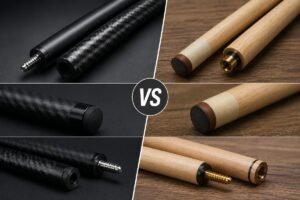
Choosing the right pool cue shaft can have a significant impact on your playing experience. Today, two of the most popular shaft materials are carbon fiber and maple.
Traditional maple shafts are known for their natural feel, classic appearance, and long history in cue making. Carbon fiber shafts, meanwhile, have become increasingly popular because of their low deflection, dimensional stability, durability, and consistent performance.
So, which is better: a carbon fiber pool cue shaft or a maple shaft?
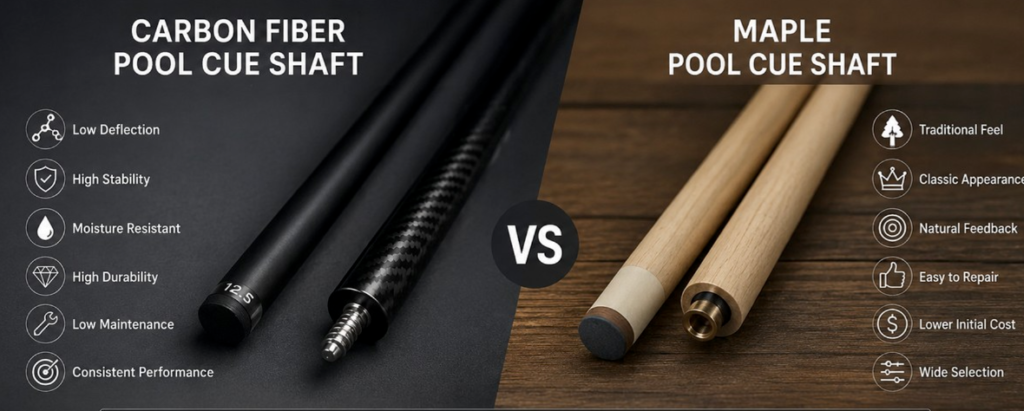
The answer depends on your playing style, performance requirements, budget, and personal preference. This guide compares the two materials in the most important areas.
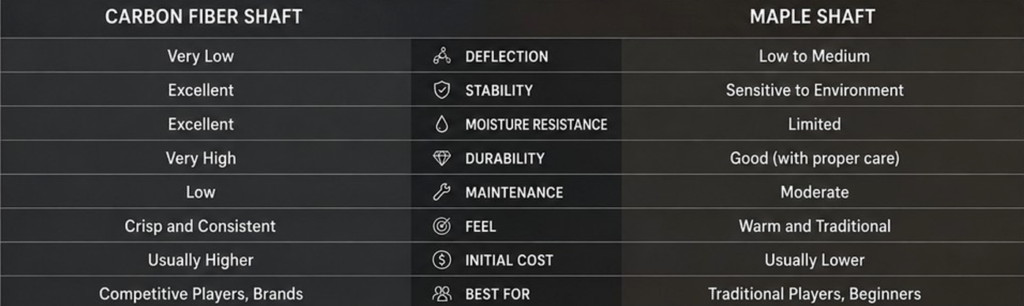
1. Carbon Fiber Shaft vs. Maple Shaft: Quick Comparison
| Feature | Carbon Fiber Shaft | Maple Shaft |
|---|---|---|
| Deflection | Low | Low to medium, depending on design |
| Stability | Excellent | More sensitive to environment |
| Moisture Resistance | Excellent | Limited |
| Warping Resistance | Excellent | Requires proper storage |
| Durability | Very high | Good with proper care |
| Maintenance | Low | Moderate |
| Feel | Crisp and consistent | Warm and traditional |
| Appearance | Modern | Classic natural wood |
| Customization | Excellent for OEM production | Excellent |
| Initial Cost | Usually higher | Usually lower |
| Best For | Competitive players, brands, frequent travelers | Traditional players, beginners, classic cue users |
There is no universal winner. Carbon fiber generally has an advantage in consistency, stability, and low-deflection performance, while maple remains attractive for players who prefer traditional feel and natural wood characteristics.
2. What Is a Carbon Fiber Pool Cue Shaft?
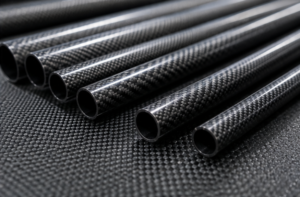
A carbon fiber pool cue shaft is manufactured using carbon fiber composite materials rather than traditional solid wood.
Carbon fiber offers a high strength-to-weight ratio, allowing manufacturers to engineer a shaft that is lightweight, stiff, and highly stable.
Modern carbon fiber shafts can be designed with different:
- Shaft diameters
- Tapers
- Wall structures
- Tip configurations
- Joint types
- Stiffness levels
- Surface finishes
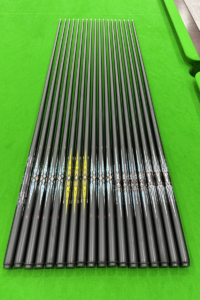
This makes carbon fiber particularly suitable for manufacturers and brands looking for consistent OEM and ODM production.
For players, one of the biggest advantages is that a properly engineered carbon fiber shaft can provide lower and more predictable cue-ball deflection, especially when using side spin.
3. What Is a Maple Pool Cue Shaft?
Maple has been one of the most widely used materials for pool cue shafts for generations.
High-quality maple shafts are appreciated for their:
- Natural appearance
- Traditional playing feel
- Familiar feedback
- Smooth flex characteristics
- Easy maintenance and repair
- Wide range of available designs
For players who have used wooden cues for years, maple provides a familiar response that can be difficult to replace.
A well-made maple shaft can also offer low-deflection performance. Low deflection is not exclusive to carbon fiber; shaft diameter, taper, front-end mass, ferrule design, and construction all influence performance.
4. Carbon Fiber vs. Maple: Deflection
Deflection is one of the biggest differences between modern carbon fiber shafts and traditional maple shafts.
When you apply side spin, the cue ball can move slightly away from the intended line. This effect is commonly referred to as cue ball deflection or squirt.
Carbon fiber shafts can be engineered with a lightweight front end while maintaining sufficient stiffness. This helps manufacturers achieve a low-deflection design.
However, it is important to understand that not every carbon fiber shaft automatically has the same deflection characteristics.
Performance depends on factors such as:
- Front-end mass
- Shaft diameter
- Taper
- Ferrule
- Tip
- Internal construction
- Material layup
Therefore, when comparing shafts, players should evaluate the complete shaft design, rather than looking only at the material.
Winner: Carbon Fiber
For players who frequently use English and want predictable cue-ball response, a quality carbon fiber shaft is generally the stronger choice.
5. Feel and Feedback: Carbon Fiber vs. Maple
This is where the comparison becomes much more subjective.
A maple shaft provides the traditional feel that many players have used for decades. The natural wood structure creates a distinctive response and feedback through the cue.
Carbon fiber usually provides a more consistent and direct feel. Some players describe it as crisp or firm, while others prefer the softer and more natural feedback of maple.
Therefore:
Choose carbon fiber if you prefer:
- A firm and consistent response
- Modern playing characteristics
- Reduced vibration variation
- Consistent performance
Choose maple if you prefer:
- Natural wood feedback
- A warmer feel
- Traditional cue characteristics
- Classic craftsmanship
Winner: Personal Preference
There is no objective winner in this category.
6. Durability and Straightness
Another major advantage of carbon fiber is dimensional stability.
Wood naturally responds to changes in environmental conditions. Humidity, temperature, and improper storage can affect maple over time.
Carbon fiber composite materials are much less affected by normal changes in humidity and temperature.
This makes carbon fiber particularly attractive for:
- Professional players
- Tournament players
- International travelers
- Pool halls
- Cue distributors
- Billiard brands
For example, a player who regularly travels between different climates may prefer carbon fiber because the shaft is designed to maintain its characteristics more consistently.
Winner: Carbon Fiber
7. Maintenance
Carbon fiber shafts are generally easier to maintain.
The smooth outer surface can usually be cleaned regularly to remove:
- Chalk
- Oil
- Dust
- Hand residue
Maple shafts require more careful maintenance because the wood surface can gradually become dirty or damaged through regular use.
Proper storage is also important for maple shafts.
For both materials, players should avoid unnecessary impact, excessive heat, and improper storage.
Winner: Carbon Fiber
8. Weight and Balance
Shaft weight is another factor that affects how a pool cue feels.
Carbon fiber allows manufacturers to engineer lightweight structures while maintaining stiffness. This gives manufacturers greater flexibility when adjusting:
- Shaft weight
- Balance point
- Front-end mass
- Stiffness
- Overall cue performance
Maple naturally has its own density and grain characteristics, so achieving exactly the same specifications from piece to piece can require careful wood selection and processing.
For OEM manufacturers, this consistency is particularly important because customers expect every shaft in the same model to have similar specifications.
Winner: Carbon Fiber for Production Consistency
9. Carbon Fiber vs. Maple for OEM Pool Cue Manufacturing
For pool cue brands, distributors, wholesalers, and importers, the comparison is not only about playing performance.
Manufacturing consistency is equally important.
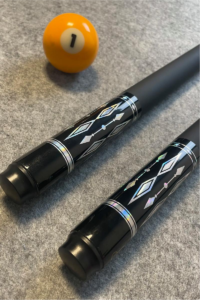
A carbon fiber pool cue shaft can be engineered around standardized production specifications, making it suitable for customized OEM and ODM projects.
Brands can potentially customize:
- Shaft diameter
- Shaft length
- Joint
- Taper
- Finition de la surface
- Logo
- Packaging
- Weight
- Performance characteristics
For example, a billiard brand may want to develop a custom carbon fiber shaft with its own logo, specifications, joint system, and packaging.
This is where working directly with an experienced carbon fiber pool cue manufacturer can provide advantages in product development and production control.
10. Which Shaft Should You Choose?
Choose a Carbon Fiber Pool Cue Shaft If:
- You want lower-deflection performance
- You frequently use side spin
- You play competitively
- You travel frequently
- You want high dimensional stability
- You prefer consistent performance
- You want low maintenance
- You are developing a modern billiard brand
Choose a Maple Shaft If:
- You prefer traditional cue feel
- You enjoy natural wood craftsmanship
- You are accustomed to wooden shafts
- Budget is an important consideration
- You prefer classic cue aesthetics
- You play mainly recreationally
Both materials can produce excellent pool cues. The right choice depends on what matters most to the player.
11. Carbon Fiber or Maple: Which Is Better?
For modern performance, stability, durability, and consistent low-deflection characteristics, carbon fiber has a clear advantage.
For traditional feel, natural appearance, craftsmanship, and affordability, maple remains an excellent choice.
The important point is that the material itself is only one part of shaft performance.
A high-quality carbon fiber shaft requires careful control of:
Carbon Fiber Material → Layup → Molding → Curing → CNC Machining → Sanding → Assembly → Quality Inspection
The manufacturing process and quality-control standards can have a major influence on the final performance of the shaft.
For this reason, if you are purchasing carbon fiber shafts in bulk or developing your own billiard cue brand, choosing the right OEM/ODM manufacturer is just as important as choosing the material.
12. FAQ
Is carbon fiber better than maple for pool cues?
For players looking for low deflection, stability, durability, and consistent performance, carbon fiber is generally the better choice. Maple remains a strong option for players who prefer traditional feel and natural wood characteristics.
Does carbon fiber have lower deflection than maple?
Many modern carbon fiber shafts are engineered for very low deflection. However, actual performance depends on shaft construction, diameter, taper, front-end mass, ferrule, tip, and other design factors.
Do carbon fiber pool cue shafts warp?
Carbon fiber is highly resistant to the environmental changes that can affect wood shafts. It is therefore much less susceptible to warping under normal conditions.
Are maple shafts still good?
Absolutely. High-quality maple shafts can provide excellent performance and remain popular among players who prefer traditional cue feel.
Can I customize a carbon fiber pool cue shaft?
Yes. Depending on the manufacturer, carbon fiber shafts can be customized in areas such as diameter, length, joint, taper, logo, finish, and packaging. This makes them suitable for OEM and ODM projects.
Conclusion
Carbon fiber vs. maple is not simply a question of old technology versus new technology.
Maple remains an excellent choice for players who value traditional feel, natural beauty, and classic craftsmanship.
Carbon fiber is better suited to players and brands that prioritize low deflection, durability, environmental stability, consistent performance, and modern manufacturing.
For billiard brands, wholesalers, and distributors, carbon fiber also provides greater opportunities for OEM and ODM customization.
If you are looking for a reliable carbon fiber pool cue shaft manufacturer, Cheval Carbon can provide customized carbon fiber cue shafts and complete OEM/ODM solutions for billiard brands and distributors.